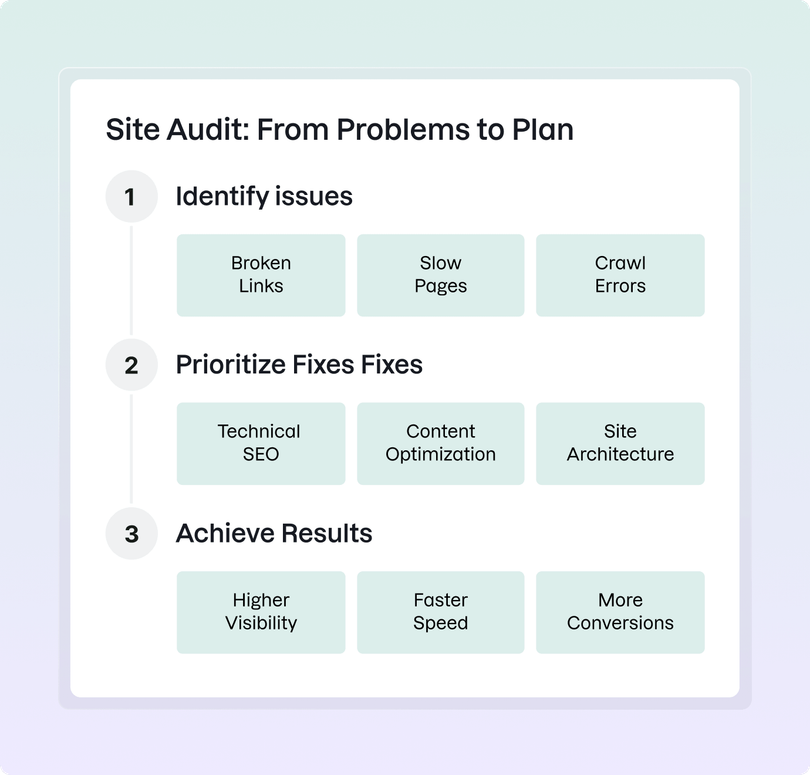

A website can look polished and still be difficult for search engines to crawl, slow on mobile, or unclear about the questions it answers. For publishers and businesses that rely on organic traffic, an SEO audit helps replace guesswork with evidence. The useful outcome is not a long list of warnings; it is a short, prioritised plan that connects site issues to reader experience and marketing goals.
That distinction matters because audit tools can generate more findings than a small team can address at once. A missing image description, a slow page and a broken navigation path are not equally urgent. Reviewing the site systematically—and recording why each fix matters—helps teams spend time where it is most likely to improve usability and discoverability.
Start with the technical foundations
Technical checks establish whether search engines and visitors can reach important pages reliably. Begin by testing a representative set of URLs, including the homepage, category pages, recent articles and high-value landing pages. Look for pages that return errors, redirect unexpectedly, or cannot be reached through ordinary site navigation.
Next, check whether the site works well on phones. Small text, crowded menus, intrusive pop-ups and buttons that are hard to tap can frustrate readers even when a page technically loads. Page speed is another practical concern: compare important pages on mobile and desktop, then investigate unusually slow results rather than treating every small fluctuation as a crisis.
Other useful checks include whether the sitemap is current, whether pages intended for search are indexable, and whether duplicate versions of a URL are being created. A technical problem deserves priority when it blocks access to valuable content or affects many pages. A minor warning on a low-traffic page may be better scheduled for later.
Review pages for clarity and search intent
On-page SEO is not simply a matter of inserting phrases into headings. A page should make its subject clear to a reader and deliver what that reader came to find. Review the title, main heading, introduction and subheadings together. Do they accurately describe the page? Does the article answer the central question early, or make visitors search through unrelated background first?
Check that titles and descriptions are distinctive, images have useful alternative text where appropriate, and internal links help people move to relevant material. Avoid adding links merely to increase their number. A good internal link gives context and a next step, such as connecting a news explainer to an earlier report or a practical guide.
Content reviews should also look for overlap. If several pages answer nearly the same question, decide whether they serve genuinely different audiences or whether one stronger, updated resource would be clearer. Consider accuracy, freshness and completeness, especially in fast-changing areas such as technology and digital marketing. Updating useful material can be more effective than publishing another article that repeats what the site already says.
Assess backlinks without chasing volume
Links from other websites can help people discover a publication, but a large number alone does not establish quality. Review which pages attract links and whether those links come from relevant, credible sources. Investigate suspicious patterns or sudden changes, but avoid assuming that every unfamiliar link requires action. The aim is to understand the profile and protect the site from risky practices, not to pursue a numerical target without context.
For teams that need a repeatable way to capture these observations, iCopify’s free SEO audit framework offers a fillable template covering technical health, on-page SEO, content and backlinks. Recording evidence, scores and proposed fixes in one place makes it easier to compare sections and explain decisions to colleagues.
Prioritise fixes by impact and effort
Once findings are collected, sort them into a manageable queue. A simple scoring approach can consider three questions: How many important pages are affected? How much does the issue hinder readers or search access? How much work will a reliable fix require? The exact scale matters less than applying it consistently and noting the reason behind each score.
- Address blockers first. Fix errors that prevent key pages from loading, being indexed or functioning on mobile.
- Group recurring problems. A template-level issue may affect dozens of pages, so one development change can have broader value than editing them individually.
- Schedule content improvements. Refresh outdated information, clarify weak introductions and resolve overlap where there is a clear reader benefit.
- Recheck after changes. Confirm that the fix worked and monitor relevant traffic or engagement over time.
Some improvements, such as rewriting a title or correcting a broken link, may be straightforward. Others involve theme code, page templates, performance or integrations. When specialist help is needed, teams should define the task, access requirements, expected deliverables and acceptance criteria before work begins. For publishers weighing a WordPress developer for blogs, Osdire’s guide to hiring a WordPress developer online explains how to compare skills, costs and potential warning signs.
Make auditing a regular habit
An audit is most useful when it becomes part of ordinary site maintenance rather than a one-off rescue exercise. Revisit priority pages after major redesigns, migrations or publishing changes, and review the backlog at regular intervals. Keep a record of what was changed and what happened afterward. That history helps teams distinguish effective fixes from assumptions and gives future editors and developers a clearer starting point.
SEO work rarely depends on one dramatic adjustment. Consistent checks, sensible prioritisation and a focus on readers can reveal preventable problems and make a website easier to use. A concise audit plan gives marketing and editorial teams a shared view of what needs attention—and a practical way to decide what to do next.